

The planets in our Solar System show a strong alignment between their orbital axes and the Sun’s rotation axis (stellar obliquity, ψ). Exoplanets, however, do not always follow this pattern. Three decades of observations reveal that many exoplanets can be significantly misaligned, including those on nearly polar or even retrograde orbits.
Sub-Saturns, planets smaller than Saturn but larger than Neptune, have recently been reported to preferentially occupy near-polar orbits. Yet thiså conclusion has been based almost entirely on systems with cool stars. Measurements of stellar obliquity for sub-Saturns around hot stars remain extremely limited, and this scarcity of data hinders deeper investigation into the mechanisms capable of generating such extreme orbital tilts. Expanding the census into the hot-star regime is therefore essential for testing whether the polar preference persists and for constraining the underlying excitation processes.
Projected stellar obliuiqty as a function of stellar effective temperature for transiting sub-Saturns and hot Jupiters.
In this work, the team presents the stellar obliquity of a rare sub-Saturn system orbiting a hot star and finds that the planet follows a nearly polar orbit (ψ = 72°). Placed in a broader context, the team quantifies the differences between hot Jupiters and sub-Saturns and finds that their obliquity distributions around cool stars differ at the 5.2σ level. At the same time, the near-polar configuration in this hot-star system aligns with predictions from the secular resonance crossing mechanism proposed by Prof. Petrovich and collaborators in 2020.
This study is led by IU astronomy graduate student Emma Dugan and was highlighted as an AAS Press Release(https://www.youtube.com/watch?v=Z7niXAHqkLg&t=800s)
The full article is available at: https://iopscience.iop.org/article/10.3847/2041-8213/ae18c7
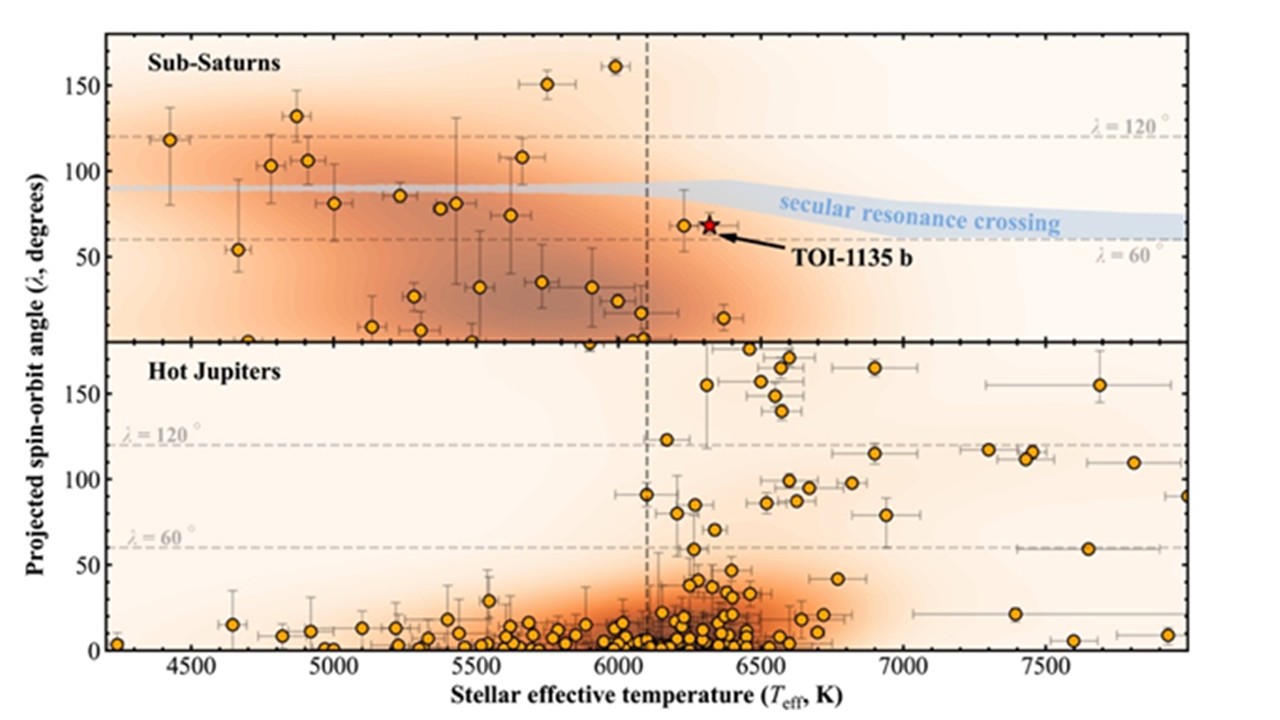
Figure: Projected stellar obliuiqty as a function of stellar effective temperature for transiting sub-Saturns and hot Jupiters.
 The College of Arts